The American Hymn Tradition, newly interpreted by pianist James Siddons in arrangements for piano solo, piano ensemble, and organ.
Beginning in the 1980s, James Siddons became interested in composing new interpretations of Protestant hymns for piano solo, evoking the spirit of the American church piano tradition. His CD "Reflections on Favorite Hymns" (2001; Major MGR 1578) has some of these arrangements. As these new interpretations became increasingly elaborate, James Siddons created a new musical form, the Sonata Hymnica, in which to present these recital-quality interpretations in a multi-movement form. Some os these sonatas are for piano ensemble; one also calls for a soprano solo and liturgical dancers
Click here to go to the Home page.
Piano
Click on any link below to purchase a score, hear an audio recording, or see a video performance of pianist James Siddons.
"El Shaddai"
A dynamic, virtuosic piano solo based on the melody of the contemporary Christian song "El Shaddai" most famous by Amy Grant in 1983. This arrangement draws on style elements of Bach, Liszt, and Ravel in creating an ever-changing panorama of musical effects. Appropriate for professional and university-level performers as well as use as prelude music in worship. Available from SheetMusicPlus. Also available as an organ work (scroll down to Organ Works).

Pass Me Not. To watch a video of a live performance by James Siddons of his improvisation on the tune of "Pass Me Not, O Gentle Savior," click here.
.jpg)
Sonata Hymnica Series
Composer James Siddons draws on the ethos of American rural hymns and spirituals to create evocations of the deeper, larger meaning of familiar church melodies. These sonatas for piano solo explore these deeper meanings in a variety of contemporary musical influences, while keeping in mind the acoustics of small rural churches of the late nineteenth century, with wooden floors and walls, high ceilings, and dimensions determined by local builders who knew how to shape a room for excellent acoustics in an age of no electricity and no microphones. These sonatas are but partly about the specific melodies and words, and mostly about their meaning in spiritual contemplation . . . and the piano, resonating, reverberant, sometimes whispering---as a sacred harp.
Although these sonatas have no specific titles, the first sonata may be thought of as the Prayer Sonata, the second as the Travel Sonata, as in a spiritual journey, and the third sonata is about our greatest fear, that of being alone and without God.
Sonata Hymnica No. 1
.jpg)
I. In the Sweet By and By
II. Sweet Hour of Prayer
To preview or purchase this score, or listen to a recording, click here.
Sonata Hymnica No. 2

I. Farther Along
II. Ivory Palaces
III. Epilogue: Lord, I'm Coming Home
To preview or purchase this score, or listen to a recording, click here.
Sonata Hymnica No. 3

I. Were You There?
II. Sometimes I Feel Like a Motherless Child
To preview or purchase this score, or listen to a recording, click here.
Sonata Hymnica No. 4
.jpg)
I. When Sea Billows Roll (based on tune of "It Is Well With My Soul")
II. Exchange It for a Crown (based on "The Old Rugged Cross")
To see or purchase the score, or hear a recording, click here
Sonata Hymnica No. 5
.jpg)
I. When I Survey the Wond'rous Cross (HAMBURG Tune)
II At the Cross (Campmeeting song)
III. Rock of Ages (TOPLADY Tune)
To see or purchase the score, or hear a recording, click here.
Sonata Hymnica No. 6

For piano ensemble of 3 or 4 pianists and 2 or 3 pianos, and, preferably, with a conductor to guide the ensemble through the complex rhythms. The music evokes the call-and-answer singing and shouting of 19th-century campmeetings, especially those of African Americans. The climactic concluding section uses fragments of the "Halleujah" Chorus of Handel's oratorio Messiah.
To see or purchase this score, or hear a recording, click here.
Sonata Hymnica No. 7
For Soprano, Liturgical Dancers &
Two Pianos (4 Hands)

Movement I, “Climbing Higher,” is based on the African American spiritual “We Are Climbing Jacob’s Ladder.”
The sustained chords, open harmony, and hammer-stroke rhythm evoke the ascent of a mountain climber. The
listener will notice polytonality in the music; the score is visually even more so, with many passages writing the
Piano I, Piano II, and Soprano parts in different keys simultaneously.
Movement II, “The Solid Rock,” is based on the hymn “My Hope is Built on Nothing Less” (1834) by Edward
Mote (1797-1874), a Baptist pastor in London and, in 1848-74, Horsham, Sussex. The soprano sings brief
lines from the hymn, interspersed with long passages for the pianos (only) that explore many tonal and rhythmic
qualities of the original hymn tune. The driving harmony, albeit in duple meter, makes this the scherzo movement
of this sonata. The rhythm's power is created by the back-and-forth arm motion of the pianists. This
method allows for a flowing sound that yet has a slightly detached (quasi staccato) effect that up-and-down
playing of accented notes cannot achieve.
Movement III, “On Snowy Wings,” is based on “O Come, Angel Band” by the New England Methodist preacher
Jefferson Hascall (1807-1887). The present movement is close to the original hymn and requires singer and pianists to perform in the style of rural, 19th-century church music, with nasal singing and homophonic texture in the pianos. The appearance of liturgical dancers as angels with “snowy wings” brings this old hymn into the 21st century, an era of many arts in worship, of visual effects in media, and our fascination with the appearance of the old in modern settings.
To see or purchase the score, click here
Reflections on Favorite Hymns
 Reflections on Favorite Hymns. MGR-1578. Copyright 2001 James Siddons. CD album of classic and modern hymns arranged by and performed by pianist-composer James Siddons.
THESE HYMN INTERPRETATIONS are drawn from a long series of hymn interpretations for piano solo begun in the 1990s. They are attuned to the acoustics of small, rural churches in the Mid-Atlantic and Southern states, usually wooden buildings built in the 1800s. The ten tunes heard on this CD album come from that line of creativity, and are presented here in a playlist order that, like a 19th-century cycle of art songs, takes the listener on a journey; albeit a spiritual journey. (Consequently, this album should not be listened to in random order.)
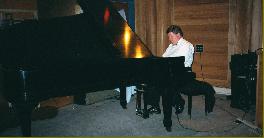
According to James Siddons, "These recordings were made in 1999 at the Major Recording Studio in Waynesboro, Virginia (U.S.A.). The recording engineer was Gary Major, son of studio founder John Major. When the studio closed in 2004, it had been the scene of almost half-a-century of recordings by local and semi-professional musicians in the Mid-Atlantic region; their usual genre was some form of country music or gospel music. And the studio had a well-worn Steinway grand piano made in 1899. Although my musical training was in the fine arts tradition, with study at several universities in London, the U.S., and Tokyo, the origin of these hymn arrangements in the context of old churches in rural Virginia meant that recording them on a century-old piano in this particular recording studio was bound to result in an unusually beautiful and authentic musical ambience. Simply put, the sound and feel of these recordings could not have been created anywhere else.
"Familiar hymns have a way of taking on a meaning larger than that of their words and music. "Amazing Grace," and "Just As I Am," among many others, have been sung so many times at worship services, memorial and prayer services, camp meetings, and other highly-charged events that the collective memory of those occasions becomes itself a deeper and more timeless meaning of the song. In composing and performing these reflections on familiar hymns, I have tried to express something of the larger and deeper meaning of each hymn, some of which are reltively modern, dating from after 1950. These recordings are especially suited for "quiet time" listening in early morning or late evening and during moments of spiritual meditation."
* Playlist: There's Something About That Name / Precious Lord, Take My Hand / There Is a Balm in Gilead / Amazing Grace / His Eye Is on the Sparrow / Plainfield Tune / Hispanic Medley 1. Cuando El Pobre (When the Poor Ones) 2. Tú Has Venido a la Orilla (Lord, You Have Come to the Lakeshore) / Just As I Am (with readings from Psalm 40 and Revelation 4 & 5 spoken by James Siddons).
Following are four selections from the CD album Reflections on Favorite Hymns:
"Amazing Grace" --- This piano solo originated in 1998 at the request of a rural Virginia family who asked that it be played at a relative's funeral. This interpretation expresses the joy of families who live in American fields, forests and mountains over many generations. This recording was made in 1999 in Waynesboro, Virginia, on a Steinway grand piano made in 1899 (see photo at top). Click to hear "Amazing Grace" by James Siddons.
"Plainfield Tune" --- Plainfield is the name of a hymn tune composed by Robert Lowry in 1876 for the hymn "What can wash away my sin? Nothing but the blood of Jesus." This interpretation is a multitrack recording, with James Siddons playing on an 1899 Steinway grand piano on one track, and on a 1983 Kurzweil K-250 synthesizer on two other tracks, one for a virtual flute, and one for a virtual men's choir resembling the sound of a medieval choir of monks. Click Plainfield Tune to hear this recording. To preview or purchase the score for organ or piano solo, click here.
"There Is a Balm in Gilead" --- This well-known spiritual is presented here in mid-twentieth century jazz harmony as well as passages that recall the Hammond B-3 organs used in black gospel worship services. Click here to hear this recording.
"Just As I Am" --- This hymn reflection is cinematic in concept, and has the broad sweep of a film score. James Siddons is heard reading verses from Psalm 40 and from The Book of Revelation, Chapters 4 and 5 (KJV), as well as performing on the 1899 Steinway grand piano. Click to hear this recording.
* Some comments received from listeners: Mr. Siddons is a superb and sensitive musician; his piano playing and his words reflect his love of God, his love of mankind, his wishes for peace...It's a c.d. I'll always take with me...---Hispanic working mother in northern Virginia// ...a very peaceful and lovely interpretation of some of my favorite hymns. It takes me right back to my childhood church and all the happiness and security that I felt there---public school teacher// I found it to be marvelous "listening" music, but after having "listened" to it, I then heard it as a spiritual reflection/meditation. I thus appreciate the multiple gifts--and the multiple opportunities for hearing--that you bring to bear in this single recording--Prof. Karen B. Westerfield Tucker, Boston University School of Theology// The CD is beautiful...and it is powerful---a church musician in Virginia/ I did get the CD. What a wonderful blessing you are. I love the music and so do my friends---Kimberly Easton, former reporter at WZZM Channel 13, Pittsburgh, Pennsylvania// I've enjoyed it daily...you did a beautiful job and I plan to play it often for other residents---retired missionary in a North Carolina nursing home (32 years in China, Malaysia & Singapore)// Christmas Day, we enjoyed your CD. The hymn arrangements are beautiful and warmed our hearts---grandmother in Staunton, Virginia// I am listening to it as I write this. It is beautiful and soothing---an administrator at Duke University Divinity School// I have enjoyed the CD. You are apparently not only a good pastor, but a genius at the piano---retired pastor in North Carolina.
Organ Works
The following three pieces work well on pipe organ or electronic organ as preludes or postludes in worship and other services, as well as recitals. The Prelude on "Plainfield" Tune has been performed many times as in Communion. It has a repeat point that allows for as many repetitons as needed for any size congregation.
"El Shaddai"
A dynamic, virtuosic setting for organ of the tune made famous by Amy Grant in 1983. Appropriate as a reital piece for professioal or university-level performers, as well as a prelude piece. Avalable from SheetMusicPlus. Also avalable as a piano solo.

Prelude on "Plainfield" Tune
To preview or purchase (download) the score, click here.
To hear James Siddons perform this prelude on a Steinway piano and Kurzweil K250 synthesizer, click here.
Prelude on Psalm 130: Aus tiefer Noth
This prelude is derived from the anthem Psalm 130: Aus tiefer Noth composed by James Siddons in 1989. It is based on familiar hymn "Out of the Depths." To preview or purchase (download) the organ score, click here.
To examine or purchase the anthem score (SSATB + (optional) organ), click here.